Researchers develop a new synthesis method for metal-single atom catalysts that dramatically boost electrolysis-based hydrogen production
Metal single-atom catalysts (M-SACs) are highly attractive for proton-exchange-membrane water electrolysis (PEMWE), a clean and efficient hydrogen production method. However, in high-density M-SACs, metal atoms tend to aggregate, reducing catalytic activity and durability. Now, researchers from Dongguk University have developed a new synthesis method for M-SACs that prevents the aggregation of metal atoms, significantly improving the hydrogen production performance of PEMWE systems.
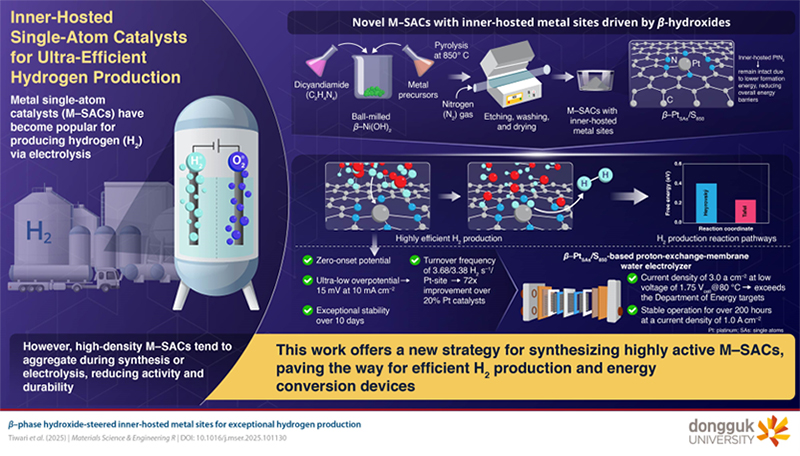
<Dongguk University Researchers propose a new synthesis method for metal-single atom catalysts>
Among clean energy sources, hydrogen (H2) has emerged as the preferred energy carrier, boasting a high calorific value and net zero carbon emissions. Proton-exchange-membrane water electrolysis (PEMWE) is a promising, clean and efficient method that produces high purity H2 with only oxygen as a by-product. Combined with renewable electricity sources, this method can contribute to sustainable H2 production.
In recent years, metal single-atom catalysts (M-SACs) have attracted growing attention for PEM water electrolysis. Because each metal atom acts as an active catalytic site, these materials use precious metals far more efficiently than conventional catalysts, potentially lowering costs while improving performance. However, in high-density M-SACs, which are most favourable for PEMWEs, metal atoms tend to aggregate either during synthesis or electrolysis, reducing both catalytic activity and durability.
To address this issue, a research team led by Assistant Professor Jitendra N. Tiwari and Professor Young-Kyu Han from the Department of Energy and Materials Engineering at Dongguk University in South Korea have developed an innovative synthesis method for M-SACs. “Our technique utilizes metal hydroxides as sacrificial templates, co-reducing them in a two-step high-temperature heat-treatment process,” explains Dr. Tiwari. “This process effectively prevents the aggregation of metal atoms due to steric hindrance, creating atomically dispersed metal single-atom catalysts.” Their study was made available online on October 28, 2025 and published in Volume 168 of Materials Science & Engineering R in January 2026.
Using β-nickel hydroxide (β-Ni(OH)₂) as the template, the researchers synthesized platinum (Pt)-based single atom catalysts called β-PtSAsS800 and β-PtSAsS850. In the process, a dried mixture of β–Ni(OH)2, Pt precursors, and dicyandiamide, was subjected to pyrolysis at 850°C or 800°C under a nitrogen atmosphere. The β–Ni(OH)2 template limits the mobility of metal ions in the mixture, while dicyandiamide provides carbon (C) and nitrogen(N). The final structure of the catalysts consists of single Pt atoms bonded to N atoms, atomically dispersed on graphitic nanosheets.
The synthesized catalysts demonstrated outstanding catalytic performance, with β-PtSAsS850 achieving an extraordinarily low overpotential of 15 millivolts and turnover frequencies 72–78-fold higher than commercial Pt/C catalysts. The material also demonstrated impressive durability, maintaining its structure and performance for more than 10 days of continuous testing. Notably, the β-PtSAsS850-based PEMWE system surpassed the U.S. Department of Energy 2026 target, indicating its potential for industrial applications. It also demonstrated robust performance for over 200 hours.
Theoretical calculations and experiments showed that this enhanced performance is due to the PtN2 catalytic sites within graphitic sheets, which significantly lower the energy barrier for hydrogen production. The researchers also synthesized M-SACs with other metals like iridium, palladium and ruthenium, demonstrating the generalizability of the approach.
“Our strategy offers a new way for synthesizing highly active M-SACs, valuable for developing highly efficient energy conversion and storage devices,” concludes Prof. Han. “Moreover, the excellent performance of the synthesized catalysts in electrolysis could help make hydrogen more economically competitive with fossil fuels for the first time. In the long term, this will accelerate hydrogen adoption, contributing to the fight against climate change.”
Reference
Authors: Jitendra N. Tiwari a,*, Muhammad Umer b, Gokul Bhaskaran c, Matthias Vandichel b, Min Gyu Kim d, Hionsuck Baik e, Yun Suk Huh c,*, Young-Kyu Han a,*
Title of original paper: β–phase hydroxide-steered inner-hosted metal sites for exceptional
hydrogen production
Journal: Materials Science and Engineering R
About Dongguk University
Dongguk University, founded in 1906, is located in Seoul, South Korea. It comprises 13 colleges that cover a variety of disciplines and has local campuses in Gyeongju, Goyang, and Los Angeles. The university has 1300 professors who conduct independent research and 18000 students undertaking studies in a variety of disciplines. Interaction between disciplines is one of the strengths on which Dongguk prides itself; the university encourages researchers to work across disciplines in Information Technology, Bio Technology, CT, and Buddhism.
About Assistant Professor Jitendra N. Tiwari
Dr. Jitendra N. Tiwari is an Assistant Professor at Dongguk University, specializing in carbon-based catalysts for energy applications. Following postdoctoral research at NCTU, Taiwan, he served as a senior scientist and research assistant professor at POSTECH and UNIST. His work focuses on advancing materials engineering for sustainable energy solutions.
About Professor Young-Kyu Han
Dr. Young-Kyu Han is a Professor in the Department of Energy and Materials Engineering at Dongguk University, Seoul, Republic of Korea. His current research interests are the atomic/molecular quantum simulation of organic and inorganic hybrid materials. He is also working on the design of new promising materials based on atomic-level simulation.