Researchers have developed a new anode-less thin film battery architecture that improves stability and battery capacity
Anode-less all-solid-state batteries (ASSBs) offer potential advantages over conventional ASSBs but are vulnerable to lithium loss, which can cause rapid capacity fading during early cycles. A new study introduces an anode-less thin-film battery featuring an ultrathin tin/carbon interlayer on a copper current collector. The interlayer helps regulate lithium deposition and improve cycling stability. The resulting battery achieved a volumetric energy density of 235.13 Wh/L at the 100th cycle under the reported test conditions.
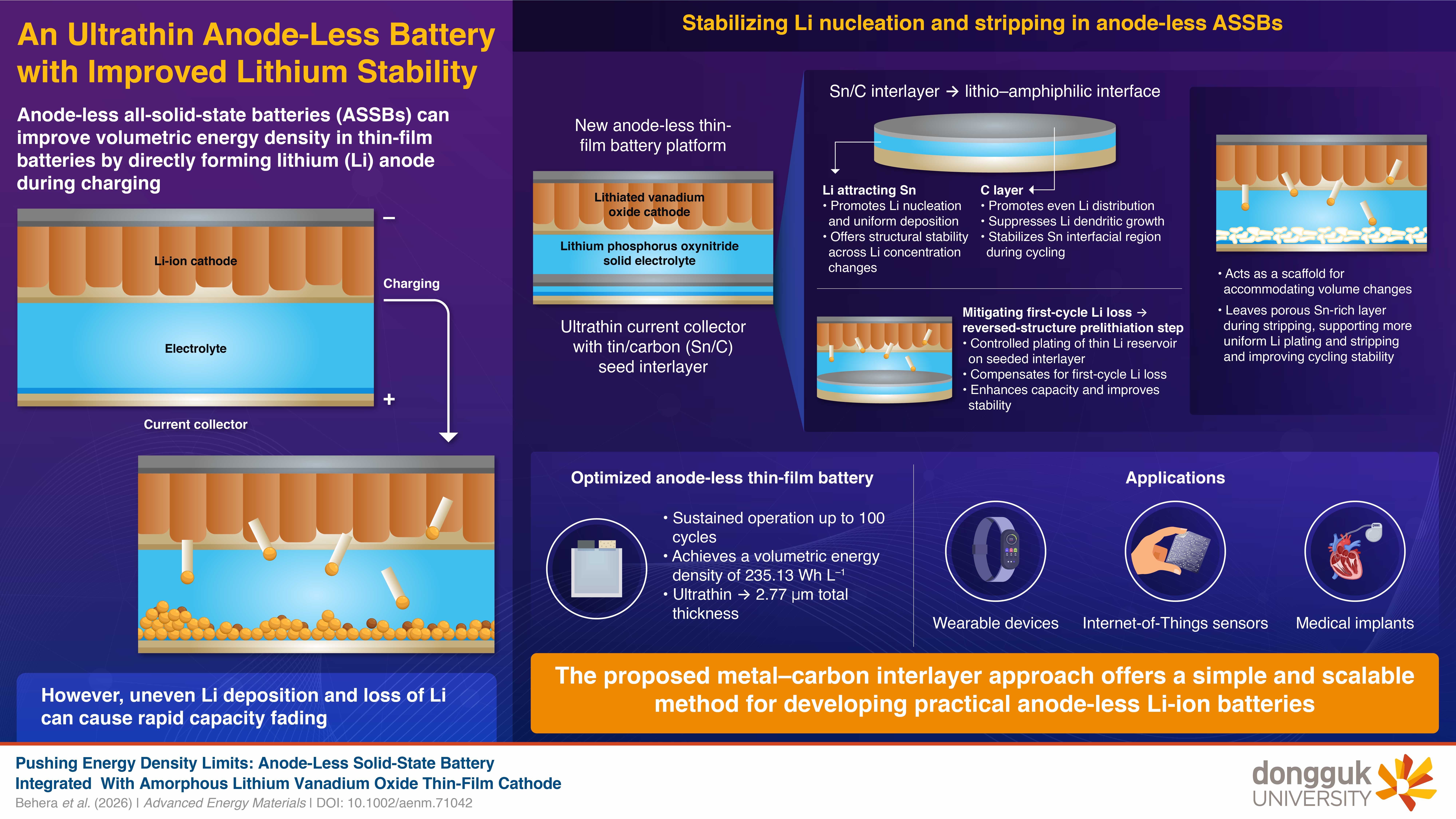
<Proposed anode-less thin film battery architecture>
All-solid-state batteries (ASSBs) are emerging as promising candidates for next-generation energy storage technologies because they use solid electrolytes instead of liquid electrolytes, offering potential advantages in safety and energy density. However, lithium (Li)-based ASSBs can suffer from instabilities caused by nonuniform plating and stripping of Li metal during operation.
A promising solution is the anode-less ASSB, in which lithium from the cathode deposits directly onto a bare current collector during the first charge, forming the anode in situ. This architecture enhances volumetric energy density and simplifies fabrication, particularly for thin-film batteries. However, it is vulnerable to lithium loss caused by uneven deposition, electrically isolated “dead” lithium, or loss of contact with the solid electrolyte during stripping, compromising battery stability and capacity.
To address these issues, a research team led by Professor Hyun-Suk Kim from the Department of Energy and Materials Engineering at Dongguk University in South Korea, has developed an anode-less thin film battery platform using an ultrathin tin/carbon (Sn/C) interlayer on the current collector to guide Li deposition. “Our interlayer acts as a seed for Li nucleation, promoting uniform Li plating and reducing Li loss and improving the reversibility of repeated charging and discharging,” explains Prof. Kim. Their study was made available online on May 07, 2026, and published in Volume 16, Issue 31 of
Advanced Energy Materials on August 19, 2026.
The researchers first systematically screened carbon-only, metal-only, and metal/carbon coatings on current collectors. Through this analysis, they found that introducing a seed/interlayer helps promote more uniform Li nucleation and plating in anode-less conditions. Among the tested configurations, Sn/C coating on a bare copper (Cu) current collector emerged as the best-performing overall configuration, demonstrating favorable Li nucleation, deposition behavior, and interfacial stability in experiments.
The team further investigated how the Sn/C bilayer improves battery performance. They found that the Sn layer promotes Li nucleation by lowering the energy barrier and enhances interfacial Li formation, while the carbon overlayer helps regulate Li growth, potentially mitigating uneven deposition and helping stabilize the Sn-Li interfacial region. The researchers also incorporated a prelithiation step after fabricating the Sn/C-coated Cu (Cu@Sn/C) current collector. In this step, a thin metallic Li layer was deposited on the modified current collector to serve as a Li reservoir that compensates for Li loss during initial cycling and supports more stable battery operation.
The resulting anode-less thin-film battery, comprising a lithium vanadium oxide (LVO) cathode, a lithium phosphorus oxynitride (LiPON) solid electrolyte, and the ultrathin Cu@Sn/C current collector, achieved a volumetric energy density of 235.13 Wh/L at the 100th cycle at a reported rate of 0.01 C. Moreover, the battery had an overall thickness of just 2.77 micrometers. The researchers also found that during initial Li plating, a three-dimensionally textured Sn/Li–Sn region formed within the interlayer and could accommodate volume and morphological changes during subsequent cycles, helping maintain interfacial stability.
“Our approach shows how interface engineering and lithium-inventory management can improve anode-less thin-film batteries,” remarks Prof. Kim. “This approach could support the development of ultrathin batteries for wearable electronics, IoT sensors, and medical devices, as well as scalable anode-less ASSBs for industrial-scale power.[A1.1][A1.2][A1.3]”
Overall, this study demonstrates an innovative approach to addressing the challenges of anode-less ASSBs, paving the way for higher capacity and longer-lasting batteries.
Reference
Title of original paper: Pushing Energy Density Limits: Anode-Less Solid-State Battery Integrated with Amorphous Lithium Vanadium Oxide Thin-Film Cathode
Journal: Advanced Energy Materials
About the institute
Dongguk University, founded in 1906, is located in Seoul, South Korea. It comprises 13 colleges that cover a variety of disciplines and has local campuses in Gyeongju, Goyang, and Los Angeles. The university has 1300 professors who conduct independent research and 18000 students undertaking studies in a variety of disciplines. Interaction between disciplines is one of the strengths on which Dongguk prides itself; the university encourages researchers to work across disciplines in Information Technology, Bio Technology, CT, and Buddhism.
About the author
Dr. Hyun-Suk Kim is currently a Professor in the Department of Energy and Materials Engineering at Dongguk University, Republic of Korea. He earned his master’s and Ph.D. degrees from Korea Advanced Institute of Science and Technology in 2003 and 2006, respectively. His research focuses on thin-film materials, electronic devices, and solid-state microbatteries. As a corresponding author of this study, he worked with collaborators to develop an ultrathin battery architecture that combines tin/carbon interface engineering with prelithiation to improve energy storage and cycling stability. He has published over 200 articles that have received over 7800 citations to date.


